The Hidden Cost of 'Just Using a Calendar' for Your Cleaning Business
Think your basic calendar is saving you money? Here's the real cost of manual scheduling for a cleaning business — and it's way more than you'd guess.
Chris Wilson
"We're fine with just using a calendar. Why would we need special software?"
I hear this all the time from cleaning business owners. And I get it—I said the same thing three years ago.
Here's what I didn't realize: using "just a calendar" was costing me thousands of dollars every year. I just couldn't see it because the costs were hidden.
Let me break down the real math.
The Time Tax: $2,080/Year (Minimum)
Let's start with the obvious cost: your time.
If you're manually scheduling cleaners, you're probably spending:
- 2 hours every week scanning calendars, checking availability, assigning jobs
- 30 minutes daily handling schedule changes, conflicts, and questions
That's 2.5 hours per week = 130 hours per year.
At just $20/hour (what you could be earning doing literally anything else), that's $2,600 per year spent on something software could do in 15 minutes.
Reality Check: That's not even counting the mental energy and stress. What's your Sunday night anxiety worth?
But here's where it gets worse...
The Mistake Tax: $200-500 Per Error
Manual scheduling means human errors. And in a cleaning business, errors are expensive:
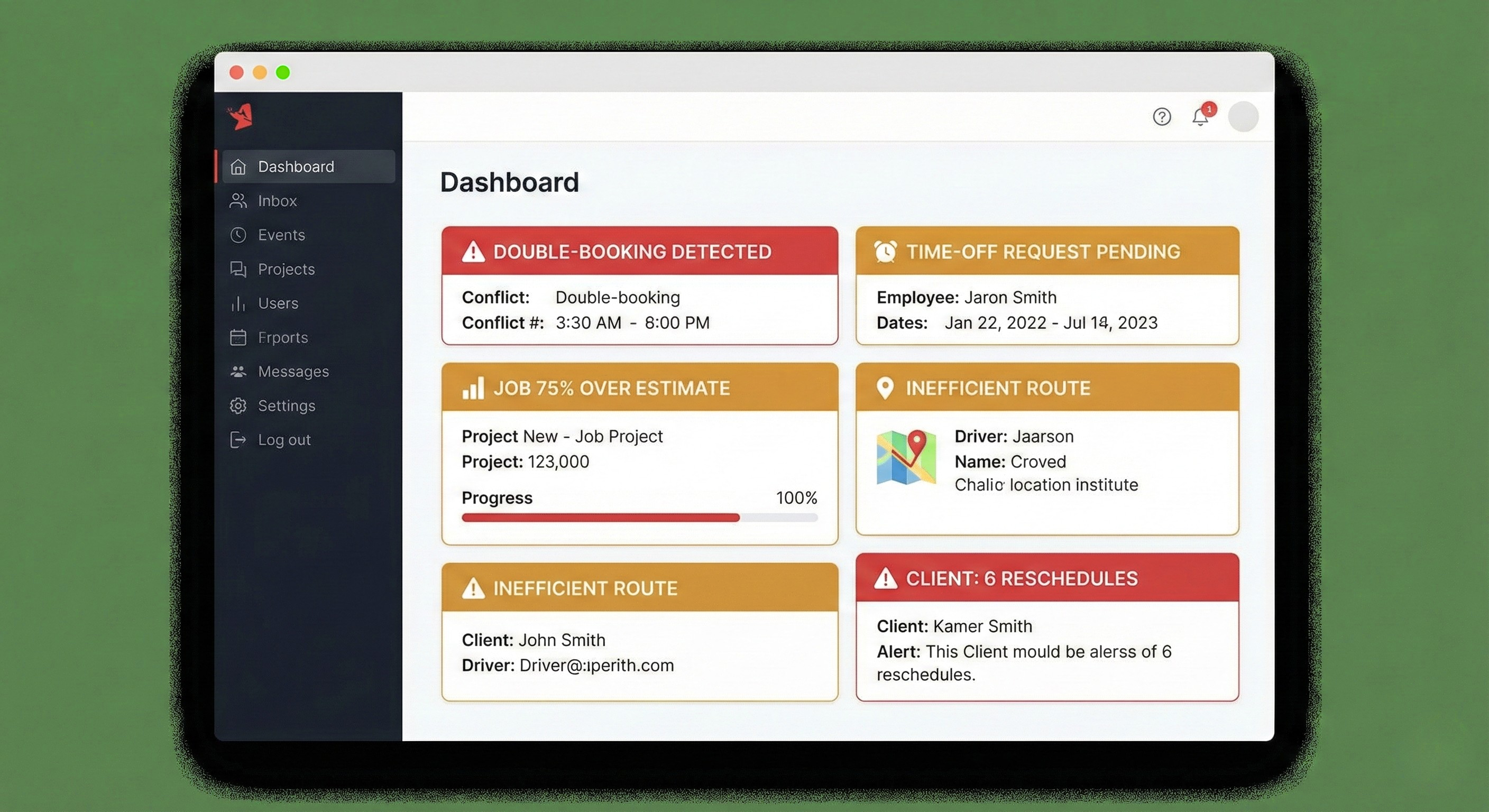
Double-bookings:
- Lost client: $200-500/month in recurring revenue
- Reputation damage: hard to quantify, but real
- Time spent apologizing and fixing: 2-4 hours
I wrote a whole post about how this specific failure keeps happening even in software marketed with "real-time conflict detection" — see why cleaning software still lets you double-book cleaners for the mechanics of why it slips through.
Missed time-off requests:
- Last-minute scrambling: 1-2 hours finding coverage
- Frustrated employees: leads to turnover
- Possible no-show: unhappy client, potential loss
Wrong cleaner assignments:
- Client complaints: time spent smoothing over
- Possible loss of client preference
- Team morale hit
I made these mistakes constantly. I lost at least 2 clients per year to scheduling errors. That's $4,800-12,000 in annual revenue, gone.
The Opportunity Tax: The Jobs You Can't Take
Here's the cost nobody talks about: the business you turn away because you can't figure out the schedule fast enough.
When a new client calls, how long does it take you to figure out if you can fit them in?
- Check calendar ✓
- Calculate drive time between jobs ✓
- See who's actually available ✓
- Verify no conflicts ✓
- Consider skill match ✓
If this takes more than 5 minutes, you're losing deals. Clients don't wait. They call the next company.
I turned down at least 1-2 jobs per month because I couldn't quickly see availability. That's $2,400-4,800/year in lost revenue.
The Cognitive Load Tax: Priceless (But Also Expensive)
This one doesn't show up on a spreadsheet, but it's real:
Every cleaning business owner I know carries their schedule in their head 24/7:
- "Did Maria ask for Thursday off or Friday?"
- "Wait, is the Johnson job recurring or one-time?"
- "Did I assign someone to that new client yet?"
You can't relax. You're always mentally checking the schedule, worrying about what you forgot.
This mental overhead costs you:
- Sleep quality
- Focus on business growth
- Time with family
- Decision-making energy
How much is peace of mind worth to you?
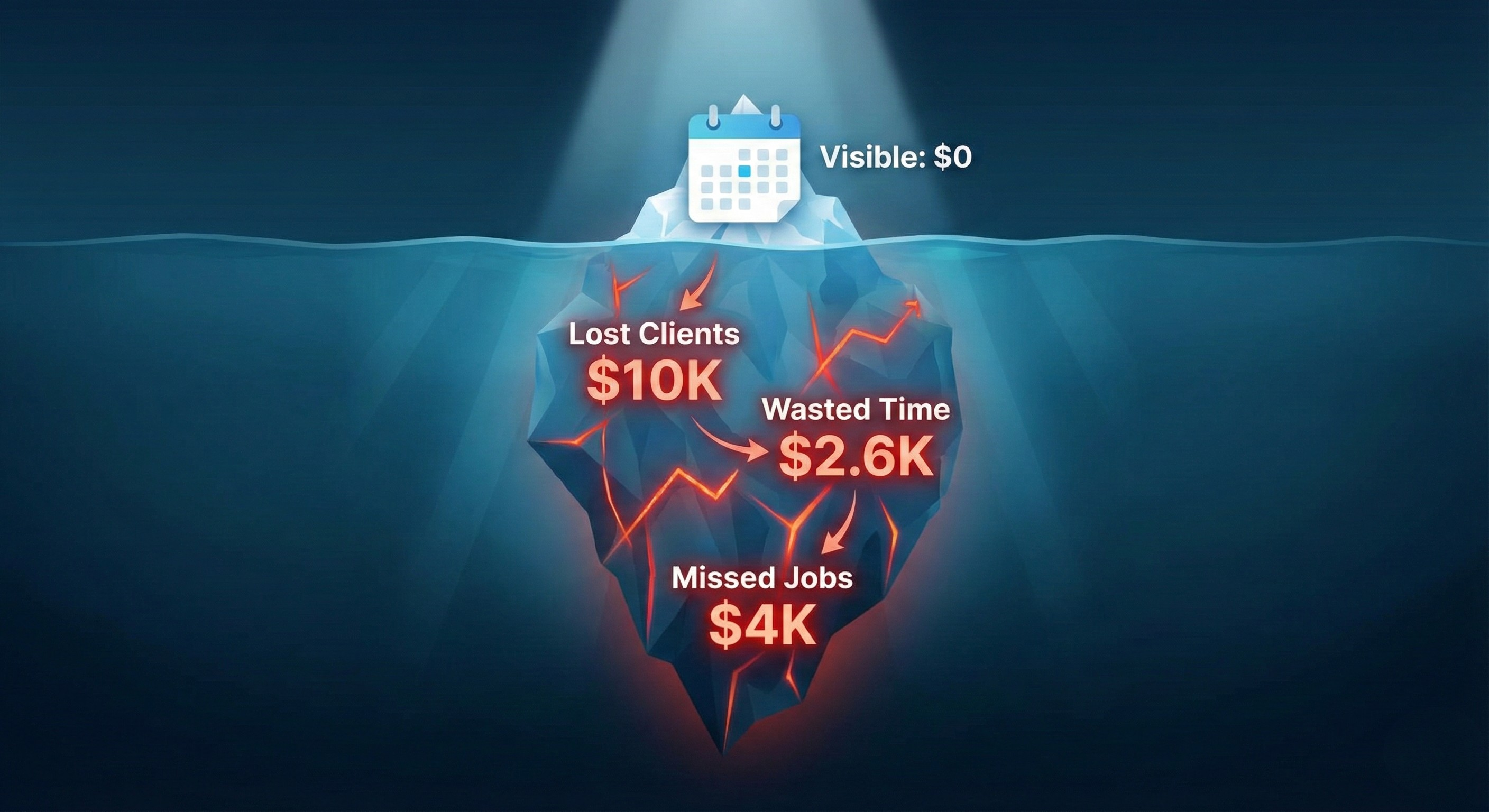
The Real Math: What "Just a Calendar" Actually Costs
Let's add it up:
| Hidden Cost | Annual Impact |
|---|---|
| Time spent scheduling | $2,600 |
| Scheduling errors (2 lost clients) | $4,800-12,000 |
| Turned down jobs (can't schedule fast enough) | $2,400-4,800 |
| Employee turnover from scheduling stress | $500-2,000 |
| Total Annual Cost | $10,300-21,400 |
The Scary Part: You can't see these costs on your P&L. They're invisible—until you fix them and realize how much you were leaving on the table.
What Changed for Me
I've written about the specific Sunday that pushed me over the edge — see why I spent 2 hours every Sunday scheduling cleaners (and how I fixed it) for that whole story. Here's the short version of what changed once I switched from "just a calendar" to actual scheduling intelligence:
Month 1:
- Scheduling time: 2 hours/week → 15 minutes/week
- Time saved: 7 hours
Month 3:
- Zero double-bookings (down from 1-2/month)
- Took on 3 new clients I would have turned down
- Extra revenue: $900/month
Month 6:
- Team stopped texting me about schedule confusion
- Sunday night anxiety: gone
- Client retention: up 15%
The ROI was immediate. The software paid for itself in the first month just from time savings alone.
The Questions to Ask Yourself
Be honest:
-
How much time do you spend scheduling every week? (Include changes, fixes, and questions)
-
How many scheduling mistakes have cost you clients? (Even one lost client = software paid for a year)
-
How many potential jobs have you turned down because you couldn't figure out the schedule fast enough? (Every "I'll have to check and get back to you" is a potential lost deal)
-
What could you do with an extra 7-10 hours per week? (Grow the business? Spend time with family? Actually take a day off?)
-
What's your stress level on Sunday nights? (If the thought of scheduling makes you anxious, there's a cost to that)
The Software Investment vs. The Calendar Cost
Let's compare:
"Just a Calendar" (Free):
- Annual cost: $0
- Hidden costs: $10,300-21,400
- Your time: 130+ hours/year
- Stress level: High
- Growth potential: Limited by your scheduling bandwidth
Scheduling Software (~$120-150/month):
- Annual cost: $1,440-1,800
- Hidden costs: Eliminated
- Your time: 13 hours/year (90% reduction)
- Stress level: Low
- Growth potential: Unlimited
Net savings: $8,500-19,600 per year.
That's not even accounting for the growth opportunities you unlock when you're not drowning in scheduling. Scheduling is just one line item, too — if you want the fuller picture of what's quietly eating your margin, I broke down the 7 hidden costs most cleaning business owners miss when calculating real profit.
The Reality: You're not paying for software. You're paying to stop losing money.
What You're Really Buying
When you invest in proper scheduling software, you're not buying a fancy calendar. You're buying:
- ✅ Time back (7-10 hours/week)
- ✅ Peace of mind (no more Sunday night anxiety)
- ✅ Growth capacity (take on more clients without added strain)
- ✅ Client retention (fewer mistakes = happier clients)
- ✅ Team happiness (clear schedules, no confusion)
- ✅ Profitability (stop losing money to invisible costs)
The question isn't "Can I afford software?"
The question is: "Can I afford to keep losing $10,000+ per year?"
See the Difference for Yourself
Want to see exactly how much time and money you could save with intelligent scheduling?
I'll show you:
- How to schedule your entire week in 15 minutes
- How automatic conflict detection prevents costly mistakes
- How availability gap cards help you take on more clients
- The exact ROI calculation for your business
No pressure. Just a cleaning business owner showing you how to stop bleeding money on scheduling.
Because "just a calendar" isn't free. It's costing you way more than you realize.
Frequently Asked Questions
How much does cleaning business software cost?
Most scheduling software costs $120-150/month ($1,440-1,800/year). But when you factor in the $10,000-21,000 in hidden costs of manual scheduling, the net savings are $8,500-19,600 per year.
Is cleaning business software worth it?
Yes. The ROI is immediate—most businesses see payback in the first month from time savings alone. Factor in prevented mistakes and increased capacity, and the ROI is 5-10x.
What's the real cost of using "just a calendar"?
The hidden costs include: $2,600/year in time spent scheduling, $4,800-12,000 in lost clients from mistakes, $2,400-4,800 in turned-down jobs, and $500-2,000 in employee turnover. Total: $10,300-21,400 annually.
How much time does scheduling software save?
Most cleaning business owners save 7-10 hours per week. That's 364-520 hours per year that can be reinvested in growing the business.
What if I can't afford software?
The question isn't "Can I afford software?"—it's "Can I afford to keep losing $10,000+ per year?" Software pays for itself by eliminating hidden costs you're already paying.
About the Author: Chris Wilson runs Gem City Cleaning Crew in Dayton, OH. After calculating how much "just a calendar" was actually costing him, he built Gem City Cleaning Tools—and saved over $15,000 in the first year.