Why Over-Automating Your Cleaning Schedule Hurts Retention
Full automation sounds great—until you lose your best cleaners. A cleaning operator explains why human-in-the-loop scheduling beats set-it-and-forget-it.
Chris Wilson
Last Updated: March 22, 2026
Every software company selling to cleaning businesses will tell you automation is the answer. Automate your schedule. Automate your dispatching. Let the algorithm handle it. Set it and forget it.
I used to believe that too. Then I watched it blow up in my own cleaning business.
I'm Chris Wilson. I co-own Gem City Cleaning Crew — 150+ residential clients, 10 cleaners, based in Dayton, Ohio. I also built Gem City Cleaning Tools, scheduling software used by over 100+ organizations. I've spent eight years in the operational weeds of running a cleaning company, and the last two years building tools that are supposed to make it easier.
Here's what I've learned the hard way: a fully automated schedule optimizes for efficiency and ignores the human stuff — and the human stuff is exactly what determines whether your cleaners stay.
The Case for Automation (It's Real)
I'm not anti-automation. Let me be clear about that upfront.
Route optimization saves real money. If you're running six cleaners across a city and you're building routes manually, you're almost certainly wasting drive time. Automated scheduling handles last-minute cancellations faster than any dispatcher can react. It catches double-bookings, fills gaps, and balances hours across your team in seconds.
These are genuine wins. The ROI is real and measurable.
The problem isn't automation itself. It's full automation — removing the human-in-the-loop entirely — without understanding what your cleaners actually value about their schedule.
What Cleaning Businesses Get Wrong About "Optimal"
When a scheduling algorithm optimizes a cleaning schedule, it optimizes for variables it can measure: drive time, hours worked, job density, skill matching.
What it can't measure:
- Maria has been cleaning the Johnson family every Thursday for three years. That relationship is why she came back after her maternity leave.
- Devon prefers to start at 9 AM so he can drop his kid off at school. If you move his first job to 7:30, he'll start looking for another job.
- Two of your cleaners have tension between them and shouldn't be paired on the same job.
- Your best cleaner only wants to work in one zip code because she drives her grandmother's car and the highway makes her nervous.
None of this is in your scheduling software. And a fully automated system will override all of it in pursuit of a 12-minute reduction in total drive time.
The real cost of a turned-over cleaner: Most cleaning business owners I've talked to put the cost of recruiting, hiring, and training a replacement cleaner at $1,500–$3,000 — not counting the cost of client disruption during the transition. A scheduling algorithm that saves you $200/month in drive time but costs you one cleaner per quarter is a bad trade. If you want to know which cleaners are actually worth protecting from an "optimal" reassignment, that starts with knowing which cleaners are actually profitable in the first place.
The Retention Data Nobody Talks About
When I was interviewing cleaning business owners while building GCCT, I kept hearing the same thing: the businesses with the lowest turnover weren't the ones paying the most. They were the ones where cleaners felt like their preferences mattered.
That sounds soft. Here's what it looked like in practice:
- Cleaners had consistent client assignments. They knew their Mondays.
- When schedules needed to change, someone asked them first.
- They weren't getting calls at 7 AM telling them their whole day was rearranged.
A fully automated dispatcher will do all three of those things. It'll reassign clients to whoever is available, reroute on the fly, and optimize your day without a single conversation. And your cleaners will feel like replaceable cogs, because the system is treating them that way.
What Human-in-the-Loop Scheduling Actually Looks Like
I'm not saying go back to a whiteboard. I'm saying the best scheduling systems use automation to handle the heavy lifting and humans to make the judgment calls.
In practice, that means:
Automation handles:
- Building the initial weekly schedule based on recurring jobs and availability
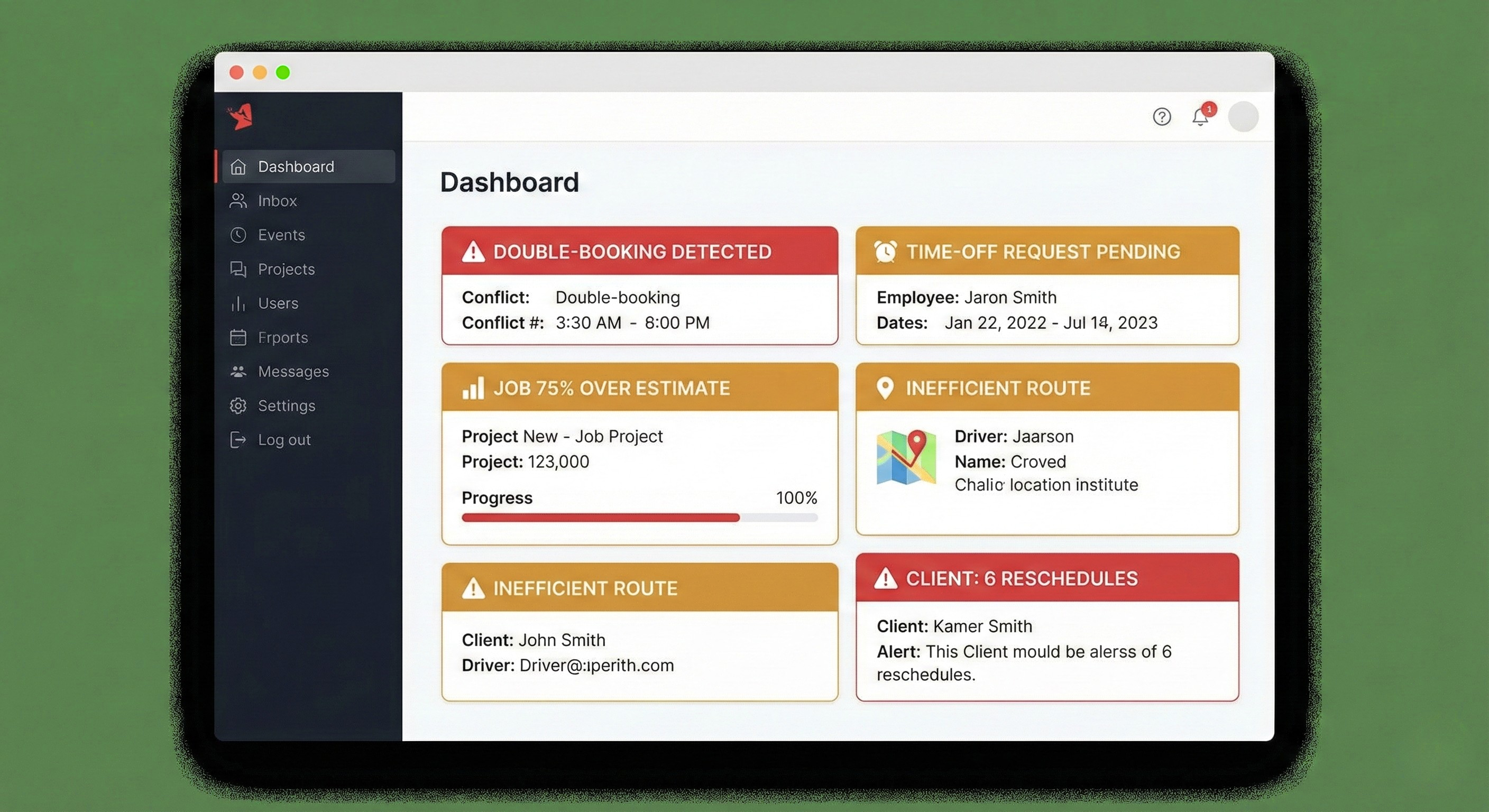
- Flagging conflicts, gaps, and scheduling problems
- Sending cleaner notifications and client reminders
- Optimizing routes within constraints you define
Humans handle:
- Approving or adjusting the generated schedule before it goes out
- Deciding whether to override a "optimal" assignment because of context the system doesn't know
- Having a conversation with a cleaner before changing their regular clients
- Making calls when something unexpected happens mid-day
The key word is "constraints." When you configure your scheduling system, you should be encoding cleaner preferences as constraints — not as suggestions the algorithm can override when efficiency is on the line.
A practical example: In Gem City Cleaning Tools, you can lock a cleaner-to-client pairing so the optimizer won't break it. You can set preferred start times that the system respects unless you override them manually. Automation operates within those boundaries. Your cleaners know their schedule is stable unless something real changes.
The Scheduling Conversation Nobody Has at Onboarding
When you hire a new cleaner, you probably talk about pay, hours, and expectations. How many of you ask:
- Which clients would you ideally want to keep long-term?
- Is there a neighborhood you'd prefer to work in?
- Do you have any constraints on your start time?
- Are there days that are harder for you?
Most owners don't ask because they're thinking about filling the schedule, not building a tenure. But in my own experience and in conversations with other owners, cleaners who feel like their preferences were considered — even partially — tend to stick around longer. If you're building that onboarding conversation from scratch, our playbook on hiring and training cleaners covers the questions worth asking before someone's first solo clean, not just after.
The best scheduling software in the world won't fix a culture where cleaners feel like inputs rather than people. But it can reinforce that culture if you configure it wrong.
The Right Balance: Automation as a Dispatcher, Humans as the Manager
Think of your scheduling software the way you'd think of a really good dispatcher. A great dispatcher knows the routes, knows who's available, knows the client preferences — and surfaces the right information so that you (or your ops manager) can make good decisions fast.
A bad dispatcher just does whatever is most efficient and asks questions later.
Your software should work the same way. Let it do the computational heavy lifting. Keep a human in the decision seat for anything that touches a cleaner's regular life.
That's not less automation. It's smarter automation — built around the real constraints of running a business with people at the center of it.
What This Means If You're Evaluating Scheduling Software
When you're shopping for scheduling software, ask these questions that most vendors won't volunteer answers to:
- Can I lock cleaner-client assignments so they won't be auto-reassigned?
- Does the system support scheduling constraints (preferred start times, geographic preferences)?
- Does automation generate a schedule for human review, or does it push directly to cleaners?
- Can I make manual adjustments without the system immediately trying to "re-optimize"?
- Is there an audit trail so I know what changed and why?
If the answer to most of those is "the algorithm handles it," you're looking at a tool built for logistics efficiency, not for running a cleaning business with real human beings. It's the same blind spot behind why cleaning software still lets you double-book cleaners — automation that's confident it's optimizing correctly, and wrong in ways nobody notices until a person is affected.
We built Gem City Cleaning Tools to get this right. The scheduling engine generates a draft — you review it, adjust it, approve it. Cleaner preferences are constraints, not suggestions. And nothing gets pushed to your team until you're ready. See how it works →
FAQ: Automation, Scheduling, and Cleaner Retention
Does scheduling software cause high turnover in cleaning businesses?
Not directly — but poorly configured automation can contribute to it. When cleaners experience unpredictable schedules, frequent reassignments, or last-minute route changes driven by an algorithm, they feel disposable. The businesses with the lowest turnover tend to use automation to generate schedules but keep a human in the loop for any changes that affect a cleaner's regular routine.
How much does a cleaning business spend replacing a cleaner?
Most cleaning business owners estimate $1,500–$3,000 per replaced cleaner when you account for job postings, interviews, background checks, training time, and reduced productivity during the learning period. That doesn't include the cost of client disruption — some clients cancel when their regular cleaner changes.
Should I let scheduling software automatically reassign cleaners to clients?
You should be careful here. For emergency coverage (a cleaner calls in sick same-day), automatic reassignment is a practical necessity. For routine optimization — moving cleaners between regular clients to save 10 minutes of drive time — it's usually not worth the retention risk. Set locked pairings for your long-tenured cleaner-client relationships.
How do I balance route efficiency with cleaner preferences?
Configure cleaner preferences as scheduling constraints before running optimization. Most cleaning-specific software lets you set preferred geographic areas, start time windows, and client locks. Let the optimizer work within those boundaries, not around them. You'll lose a little efficiency and gain a lot of stability.
What should I tell cleaners about how the schedule is built?
Be transparent that you use software to help build schedules, and that you review and approve everything before it goes out. Tell them their preferences are in the system. If you change something that affects their regular routine, tell them before the schedule drops — not after. That conversation matters more than most owners realize.
How often should schedules be locked vs. flexible?
A useful rule of thumb: lock anything that has been stable for 30+ days and that a cleaner considers "theirs." Keep flexibility for new clients, ad-hoc jobs, and open slots where you're still figuring out fit. Most maid services can lock 60–70% of their weekly schedule and let optimization handle the remaining open capacity.
Does automation work better for commercial than residential cleaning?
Generally yes — commercial janitorial work is more compatible with full automation because the relationships are facility-to-company rather than client-to-cleaner. Residential is more personal, and the cleaner-client bond is often a retention tool on both sides. That's why the human-in-the-loop principle matters more for residential maid services than for commercial operations.